


Currency
 AED
AED
 AFN
AFN
 ALL
ALL
 AMD
AMD
 ANG
ANG
 AUD
AUD
 AWG
AWG
 AZN
AZN
 BAM
BAM
 BBD
BBD
 BDT
BDT
 BIF
BIF
 BND
BND
 BOB
BOB
 BSD
BSD
 BWP
BWP
 BZD
BZD
 CAD
CAD
 CDF
CDF
 CHF
CHF
 CLP
CLP
 CNY
CNY
 CRC
CRC
 CVE
CVE
 CZK
CZK
 DJF
DJF
 DKK
DKK
 DOP
DOP
 DZD
DZD
 EGP
EGP
 ETB
ETB
 EUR
EUR
 FJD
FJD
 FKP
FKP
 GBP
GBP
 GMD
GMD
 GNF
GNF
 GTQ
GTQ
 GYD
GYD
 HKD
HKD
 HNL
HNL
 HUF
HUF
 IDR
IDR
 ILS
ILS
 INR
INR
 ISK
ISK
 JMD
JMD
 JPY
JPY
 KES
KES
 KGS
KGS
 KMF
KMF
 KRW
KRW
 KYD
KYD
 KZT
KZT
 LBP
LBP
 LKR
LKR
 MAD
MAD
 MDL
MDL
 MKD
MKD
 MMK
MMK
 MNT
MNT
 MUR
MUR
 MVR
MVR
 MWK
MWK
 NGN
NGN
 NIO
NIO
 NOK
NOK
 NPR
NPR
 NZD
NZD
 PEN
PEN
 PGK
PGK
 PKR
PKR
 PYG
PYG
 QAR
QAR
 RON
RON
 RSD
RSD
 RWF
RWF
 SAR
SAR
 SBD
SBD
 SEK
SEK
 SGD
SGD
 SHP
SHP
 SLL
SLL
 STD
STD
 TJS
TJS
 TOP
TOP
 TRY
TRY
 TTD
TTD
 TZS
TZS
 UAH
UAH
 UGX
UGX
 USD
USD
 UYU
UYU
 UZS
UZS
 VND
VND
 VUV
VUV
 WST
WST
 XAF
XAF
 XCD
XOF
XPF
XCD
XOF
XPF
 YER
YER
 ZAR
ZAR


Ships next business day
Description
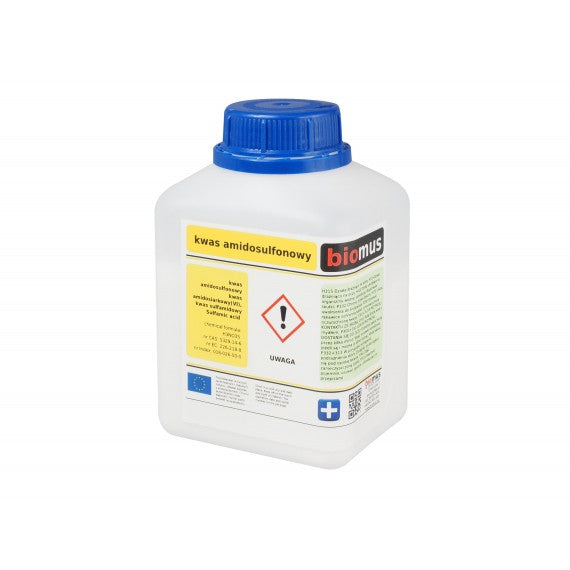
xAmidosulfonic Acid 250g BIOMUS
Technical information on chemical reagents:
- Chemical formula: H2NSO3H
- CAS number: 5329-14-6
- EC number: 226-218-8
Examples of professional applications in various industries:
- Cleaning and descaling agents: Lime removal: Amidosulfonic acid (also known as sulfamic acid) is commonly used as a powerful descaler. It is suitable for removing limescale deposits in household appliances such as coffee machines, kettles, dishwashers, and washing machines, as well as for cleaning faucets and tiles in bathrooms and kitchens.
- Industrial cleaning: Cleaning of equipment and machinery: In industry, amidosulfonic acid is used for cleaning and descaling equipment and machinery. It reliably removes limescale and other mineral deposits from heat exchangers, boilers, pipelines, and cooling circuits.
- Sanitary cleaning: Toilet cleaners and sanitary cleaners: In sanitary cleaning, amidosulfonic acid is used in toilet cleaners and other sanitary cleaning products. It helps remove stubborn deposits, urine scale, and limescale, ensuring hygienic cleanliness in sanitary areas.
- Chemical industry: Production of cleaning agents and descalers: In the chemical industry, amidosulfonic acid is used to produce cleaning agents and descalers. It is often combined with other acids and additives to develop specialized cleaning products for various applications.
- Metal processing: Pickling and rust removal: Amidosulfonic acid is used in metal processing for pickling and rust removal. It removes oxide layers and rust from metal surfaces, preparing them for subsequent processing steps such as coating or painting.
- Textile industry: Dyeing and printing of textiles: In the textile industry, amidosulfonic acid is used as an auxiliary in dyeing and printing textiles. It helps fix dyes evenly on fibers and improves color intensity.
- Laboratory applications: Analytical chemistry: In laboratories, amidosulfonic acid is used as a reagent in analytical chemistry. It serves to determine cations such as calcium and magnesium in water samples and other solutions.
- Construction industry: Concrete cleaning: In the construction industry, amidosulfonic acid is used for cleaning and descaling concrete surfaces. It removes limescale and salt deposits from concrete without damaging the structure.
- Water treatment: Removal of limescale deposits: In water treatment, amidosulfonic acid is used to remove limescale deposits in water treatment plants and pipelines. It helps maintain the efficiency of the plants and improves water quality.
- Household applications: Multi-purpose cleaners: Amidosulfonic acid is used in household cleaners suitable for various surfaces. It removes limescale, rust, and other stubborn stains in kitchens and bathrooms.
Hazard statements on the product label:
H315: Causes skin irritation.
H319: Causes serious eye irritation.
H412: Harmful to aquatic life with long-lasting effects.
Safety statements on the product label:
P102: Keep out of reach of children.
P273: Avoid release to the environment.
P280: Wear protective gloves/protective clothing/eye protection/face protection.
P302 + P352: IF ON SKIN: Wash with plenty of water and soap.
P305 + P351 + P338: IF IN EYES: Rinse cautiously with water for several minutes. Remove contact lenses, if present and easy to do. Continue rinsing.
P332 + P313: If skin irritation occurs: Get medical advice/attention.
P362 + P364: Take off contaminated clothing and wash before reuse.
P501: Dispose of contents/container in accordance with local/regional regulations.
Recommended storage conditions:
- Amidosulfonic acid should be stored in a tightly closed container, away from heat sources, sparks, and flames.
- The product should be stored in a dry and well-ventilated place.
- Exposure to moisture and high temperatures should be avoided.
- All relevant regulations for the storage of chemicals must be observed.
Printing on the packaging










- Choosing a selection results in a full page refresh.